Wall Painting
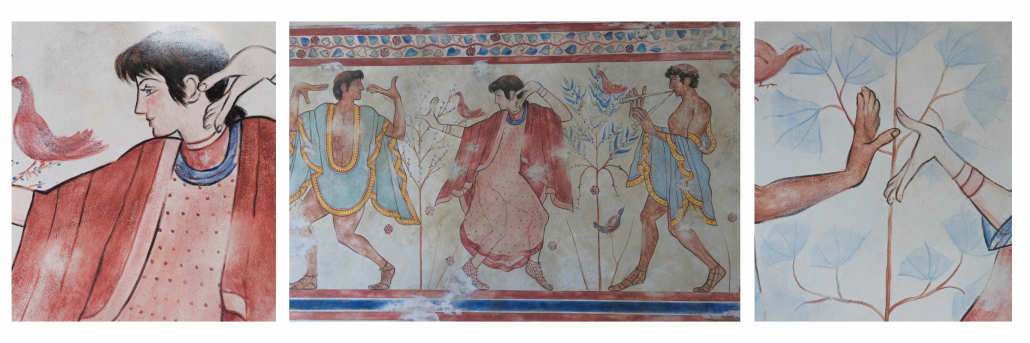
This summer, our friend and artist Diana Lenz stayed with us for a visit. She is a trained theatre artist and works for the Meiningen State Theatre. As early as 2022, she had already been kind enough to paint a large Etruscan wall painting on canvas for us, which still gives our living room its distinctive character today. This time as well, the aim was to create something lasting. Instead of working on canvas, she chose to paint directly onto the wall and, within a few weeks, created a truly unique work of art.
Even before the first lines became visible, the actual work began quietly. An intensive engagement with the characteristic structures, motifs, and stylistic elements of the Etruscans formed the basis for achieving the intended appearance of the painting from the outset. From this preparatory work, a sketch gradually developed, from which the final image slowly took shape.
Once the sketch was complete, the work on the wall began. First, she carefully applied a grid in order to transfer the drawing to scale. Step by step, the sketch was then transferred onto the surface using charcoal, forming the foundation for the later painting. Over several stages, the image gradually took shape.
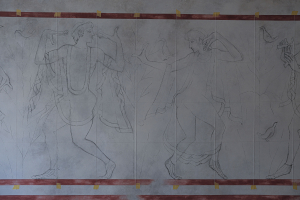
The subsequent execution was also guided by historical approaches to wall painting. The work progressed step by step, beginning with a clear linear structure, upon which the colours were gradually built up. The choice of colours was likewise based on traditional stylistic elements. With each passing day of work, the image became more condensed and gradually came together as a cohesive whole.
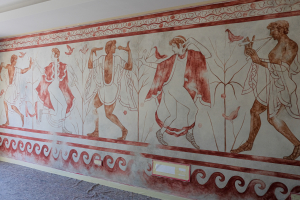
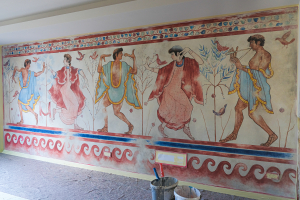
The work extended over almost three weeks and required considerable time and endurance. She often worked on the painting into the evening, and sometimes beyond.
After the painting appeared to be finished, a further bold step followed: the deliberate removal of parts of the surface. Within just a few hours, precise actions created the impression that the image had aged over centuries. In some areas exposed, in others already crumbling, the illusion emerged of a work that had been applied to this wall thousands of years ago.
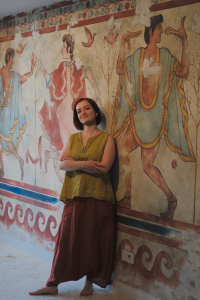
In this way, the painting beautifully connects the Podere with the history of the place.
